
 LMS
LMS
 Reels Series
Economics
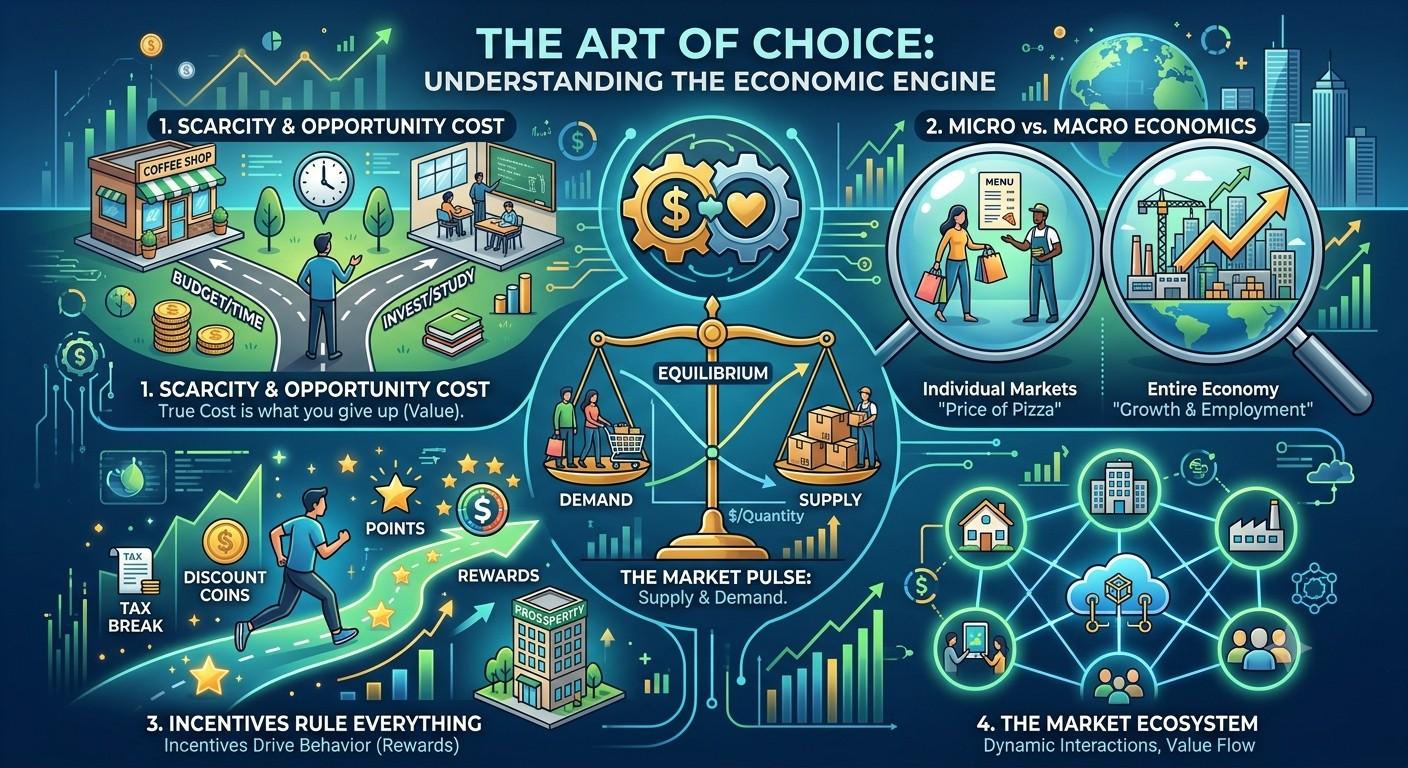
Economics often gets a bad rap as the "dismal science," full of dry charts, complex equations, and talking heads debating inflation percentages. But at its core, economics isn't about money or math — it's about **choices**.
It’s the study of how people, businesses, and societies navigate a world where wants are infinite, but resources (like time, land, and money) are strictly limited.
Here is a foundational breakdown of how the economic engine actually drives our daily decisions.
## 1. The Invisible Force: Scarcity and Opportunity Cost
Every time you choose to do, buy, or build one thing, you are actively choosing *not* to do something else. Economists call this **Opportunity Cost**.
> **The Opportunity Cost Rule:** The true cost of anything is what you have to give up to get it.
>
If a business spends $10,000 upgrading its machinery, the opportunity cost isn't just the money — it's the marketing campaign or the employee bonus they *could* have funded with that same money instead. Recognizing opportunity cost changes how you view value; it forces you to look at the hidden trade-offs in every decision.
## 2. Micro vs. Macro: Two Sides of the Same Coin
Economics is generally split into two main branches. Think of it like looking at a forest: you can study the individual trees, or you can study the entire ecosystem.
| Branch | Focus | Key Questions |
| :--- | :--- | :--- |
| **Microeconomics** | Individual choices and single markets. | How does a business price its product? What makes a consumer choose Brand A over Brand B? |
| **Macroeconomics** | The behavior of the entire economy. | What causes nationwide inflation? How do interest rates impact overall employment and growth? |
## 3. Incentives Rule Everything
People respond to incentives. Whether it's a discount on a product, a tax break from the government, or a point-based loyalty program that rewards frequent buyers, human behavior shifts when the payoffs change.
When an economy aligns incentives correctly, businesses thrive, and consumers find value. When incentives are misaligned—such as rewarding short-term volume over long-term quality—systems inevitably break down. Understanding incentives is like having a cheat code for predicting human behavior in any market.
## 4. The Law of Supply and Demand
This is the foundational heartbeat of the marketplace. It determines the price of everything from a slice of wood-fired pizza to high-end custom furniture.
* **Demand:** As the price of an item rises, consumers generally want less of it.
* **Supply:** As the price of an item rises, producers want to sell more of it to maximize profit.
The magic happens at the **equilibrium point** — the exact price where the amount buyers want to purchase perfectly matches the amount sellers want to provide.
## What Drives Economic Value?
Ultimately, value isn't arbitrary. An economy functions smoothly when value is transparent, whether that value is stored in hard currency, digital tokens, or asset equity. The most successful modern ventures are those that master these micro-incentives, creating ecosystems where every participant feels they are gaining more than their opportunity cost.

Sponsorluk
© 2026 Sngine Flutter Crafters
 Turkish
Turkish
 English
 Arabic
 French
 Spanish
 Portuguese
 Deutsch
 Dutch
Dutch
 Italiano
 Russian
 Romaian
 Portuguese (Brazil)
 Greek
Greek