
 LMS
LMS
 Reels Series
Global In-Vehicle Networking Market Expansion Through Smart Mobility Solutions
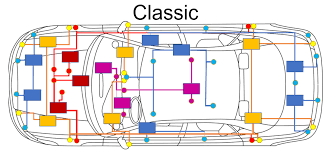
Automotive internal hardware layout is transitioning away from distributed Electronic Control Unit structures toward unified domain and zonal control frameworks. Traditionally, every distinct vehicle function—ranging from door lock mechanisms and power window controls to engine management systems—required a standalone microcontroller connected through complex, point-to-point wiring harnesses. This approach created dense, heavy, and labor-intensive wiring assemblies that increased assembly line complexity and elevated failure points. In contrast, zonal topologies consolidate localized inputs and outputs into dedicated regional controllers situated in specific quadrants of the vehicle. These regional hubs process sensor data locally before relaying consolidated, high-bandwidth communication streams to central compute modules. This architectural consolidation reduces harness length and weight, improves electrical routing efficiency, and provides automakers with modular hardware setups that can be updated across vehicle product lines without completely rewiring the physical infrastructure.
Implementing zonal domain structures fundamentally alters software deployment and network routing requirements within automotive manufacturing workflows. By decoupling dedicated functional hardware from control software, automotive software engineers can run multiple virtualized software applications on powerful central processors using hypervisors and containerization. However, this shift requires internal vehicle communication networks to manage heterogeneous data packet types on a single shared physical medium without experiencing resource contention or packet drops. Engineers utilize packet prioritization mechanisms, virtual local area networks, and dynamic bandwidth allocation algorithms to ensure deterministic routing for safety-critical instructions. Furthermore, regional controllers must maintain failure-isolation capabilities to prevent localized short circuits or physical cable degradations from impairing central system capabilities. Organizations utilizing detailed In-Vehicle Networking Market forecast data strategically evaluate hardware consolidation costs against long-term software maintainability to optimize production roadmaps for next-generation electric and autonomous platforms.
What is the main advantage of shifting from a distributed ECU model to a zonal architecture? The primary advantage is a significant reduction in vehicle weight, manufacturing complexity, and harness cost. By grouping sensor and actuator controls into localized zonal controllers, shorter wire runs are needed for peripheral devices. These zonal hubs then communicate with central processors over a streamlined high-speed Ethernet backbone, eliminating hundreds of individual dedicated copper wire runs throughout the chassis.
How do zonal architectures affect automotive software updates? Zonal architectures abstract physical hardware away from central software logic, allowing functions to be managed by centralized domain processors running server-like software stacks. This centralized software environment makes over-the-air (OTA) updates simpler to execute, as patches and features can be deployed directly to core processing units without needing complex, individual flashing routines for dozens of scattered, low-power microcontrollers.
➤➤➤Explore MRFR’s Related Ongoing Coverage In Semiconductor Industry:
Digital Transformation In Bfsi Market
Directors And Officers Insurance Market
 Turkish
 English
 Arabic
 French
 Spanish
 Portuguese
 Deutsch
 Dutch
Dutch
 Italiano
 Russian
 Romaian
 Portuguese (Brazil)
 Greek
Greek