
 LMS
LMS
 Reels Series
Is Online Counselling Effective for Anxiety and Depression? What Science Says
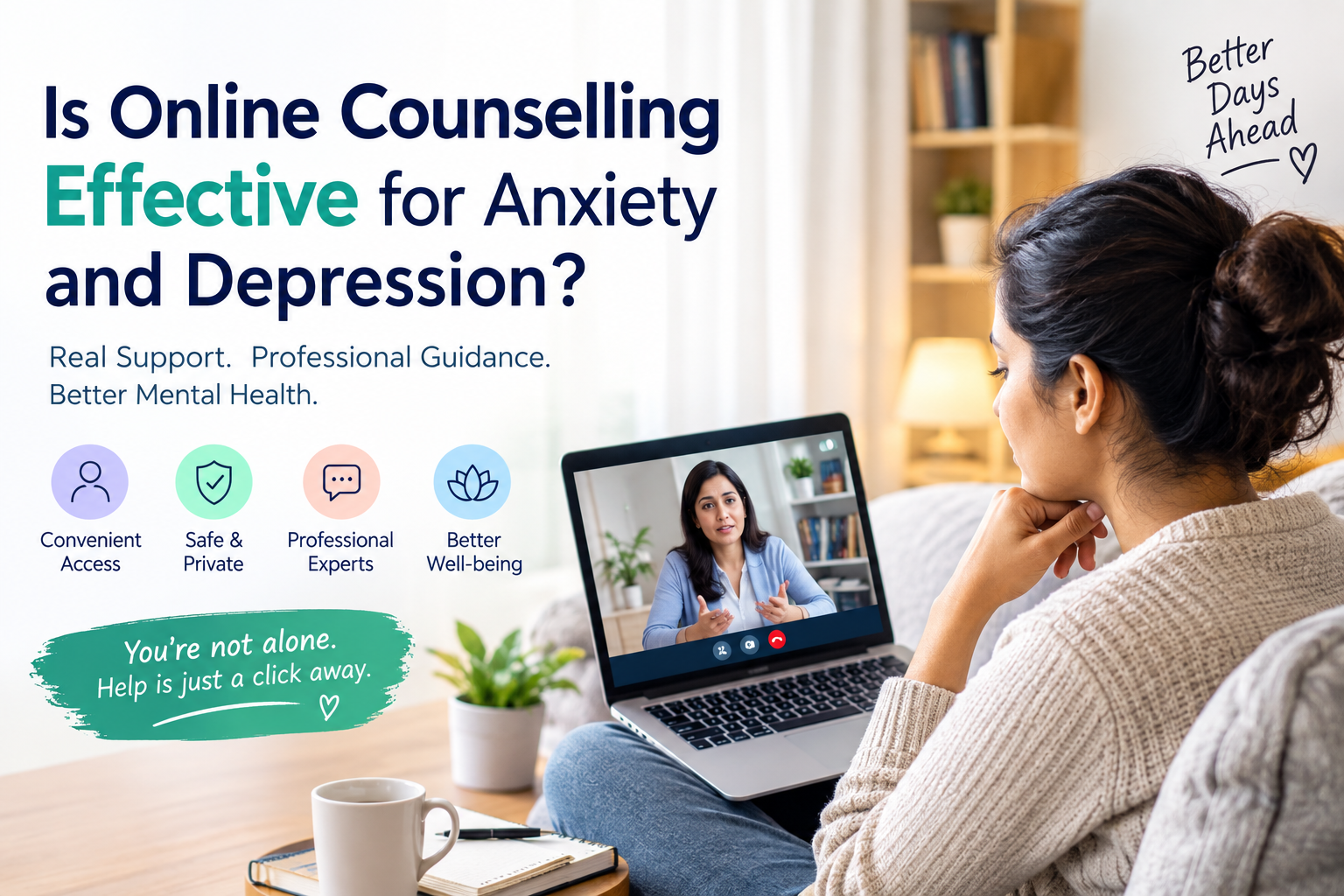
Mental health support is increasingly available beyond the traditional therapist's office. Video sessions, secure messaging, digital psychological interventions, and other forms of remote care have made professional support more accessible to people who may find conventional appointments difficult to attend. This has also raised an important question: Is online counselling genuinely effective for people experiencing anxiety and depression, or is face-to-face therapy always better?
Current research provides an encouraging answer. Evidence from systematic reviews and meta-analyses suggests that appropriately designed internet-based psychological interventions can reduce symptoms of common mental health conditions, particularly when they use established therapeutic approaches such as Cognitive Behavioural Therapy (CBT). However, effectiveness depends on the individual's needs, the severity of symptoms, the quality of the service, therapeutic engagement, and the level of professional support provided.
What the Research Shows
Research on internet-delivered psychological interventions has expanded considerably. An updated 2024 umbrella review examined 39 meta-analyses and found that internet-delivered CBT generally reduced symptoms across several conditions, with particularly substantial evidence for depressive and anxiety symptoms. The researchers also noted that evidence quality varied across studies, highlighting the importance of choosing appropriately designed interventions.
Another systematic review and meta-analysis of internet-delivered transdiagnostic treatments found meaningful reductions in both depression and anxiety compared with control conditions. The effects were generally stronger when the intervention included more active therapeutic engagement, although the certainty of evidence varied. This suggests that online care should not be viewed simply as a less effective substitute for in-person treatment. For many people, it can be a legitimate way of receiving evidence-based psychological support.
Why Online Care Can Work
Psychological therapy works through therapeutic principles rather than simply through physical proximity. Approaches such as CBT help people identify unhelpful thoughts, understand behavioural patterns, develop coping strategies, and gradually make meaningful changes.
Digital delivery can provide access to many of the same therapeutic processes. A person may discuss concerns with a qualified professional through a secure video session, complete structured exercises, review patterns between sessions, and practice new skills in everyday situations. For someone experiencing stress, this accessibility can make it easier to seek support before difficulties become more disruptive.
Evidence for Depressive Symptoms
Research specifically examining internet-based CBT has found encouraging outcomes for depression. A large individual-patient-data network meta-analysis included 39 randomized controlled trials involving more than 8,000 participants. Both guided and unguided interventions were more effective than control conditions, while guided treatment generally produced better outcomes, particularly among people with greater baseline symptom severity. This distinction is important. Digital mental health care is not necessarily equally effective in every format. Human guidance can provide encouragement, personalisation, clarification, and accountability. A person experiencing depression may therefore benefit from a structured service in which a qualified professional can adapt psychological strategies to their specific circumstances.
Evidence for Anxiety
Internet-delivered CBT has also demonstrated benefits for anxiety. Research involving university students, for example, found significant improvements in anxiety symptoms compared with control conditions. Researchers nevertheless emphasised that more work is needed to understand which treatment components and levels of guidance produce the best outcomes.
Evidence reviewed by NICE has similarly indicated that internet-delivered CBT can be effective for conditions such as generalised anxiety disorder and panic disorder, with therapist-supported digital interventions potentially offering greater benefits than completely unsupported approaches. For someone struggling with persistent anxiety, therefore, online psychological care can be a practical and evidence-supported treatment option when appropriately matched to their needs.
The Importance of Professional Guidance
Not every mental health application or online program is equivalent to therapy. There is a significant difference between reading general wellness content and receiving individualised psychological treatment. Professional support allows a therapist to understand the person's history, symptoms, relationships, coping patterns, and goals. This can help determine which strategies are appropriate. A qualified Online Counsellor can also monitor progress and help identify when additional assessment or a different level of care may be necessary.
Evidence comparing remote and face-to-face psychotherapy is also encouraging. A 2024 systematic review and meta-analysis found no statistically significant difference between remote and face-to-face psychological treatment for anxiety or depressive symptoms in the studies analysed, although the researchers noted limitations in the available evidence.
Convenience Can Improve Access
One of the strongest advantages of Online Counselling is accessibility. Individuals may not have to spend time travelling to appointments or navigating geographical barriers. Remote sessions can be particularly useful for people with demanding schedules, mobility limitations, caregiving responsibilities, or discomfort with entering a traditional mental health setting.
Convenience may also reduce one practical barrier to treatment: getting started. When professional support can be accessed from a familiar environment, some individuals may feel more comfortable taking the first step. However, convenience should complement clinical quality rather than replace it.
What Happens During Online Therapy?
The exact structure varies according to the professional and treatment approach. Sessions may involve discussing current concerns, identifying patterns of thinking and behaviour, developing coping strategies, practising communication skills, and reviewing progress. Some interventions may include homework or structured exercises between appointments.
For example, someone experiencing anxiety may learn to identify catastrophic thinking and gradually challenge avoidance patterns. Someone experiencing depression may work on behavioural activation, routine building, and reconnecting with meaningful activities.
Online Therapy can therefore involve active psychological work rather than simply talking about problems.
Supporting Everyday Emotional Skills
Therapy can also address practical psychological skills that influence mental well-being. For example, sleep difficulties can be explored when they are connected to emotional distress or unhelpful routines. A therapist may also help an individual understand anger, develop healthier communication, or strengthen emotion control.
Some people may benefit from goal setting that focuses on achievable behavioural changes rather than unrealistic expectations. Developing assertiveness can be particularly valuable for individuals whose emotional difficulties are connected to interpersonal conflict or difficulty communicating needs. These skills can complement formal treatment and support longer-term psychological well-being.
The Role of Mindfulness and Lifestyle
Evidence-based therapy does not necessarily focus only on symptoms. Psychological support may also help individuals develop healthier routines and coping strategies. Mindfulness can help people observe thoughts and emotions without automatically reacting to them. This may be incorporated into some therapeutic approaches as a complementary skill.
Attention to physical health, daily routines, social connection, and meaningful activities can also support recovery. Similarly, self-improvement can be approached in a realistic way by focusing on gradual development rather than expecting immediate emotional transformation. For individuals experiencing major life changes, therapy can also provide space to process grief and loss and understand how those experiences affect current functioning.
Is Online Therapy Suitable for Everyone?
Online treatment can be highly useful, but it is not automatically the right choice for every person or every situation. Treatment decisions should consider symptom severity, personal preferences, access to technology, privacy, communication needs, and clinical risk.
People experiencing severe symptoms, significant functional impairment, or an urgent mental health crisis may require a more comprehensive assessment and potentially additional or in-person services. Therefore, online care should be viewed as one component of a broader mental health system rather than a universal replacement for every form of psychological or psychiatric care.
How to Choose a Reliable Service
When considering online support, look for qualified mental health professionals, clear information about confidentiality, appropriate professional credentials, secure communication systems, and evidence-based treatment approaches. It is also useful to understand whether the service provides individualised sessions rather than only automated content.
Individuals seeking professional support in India may consider a Top Psychologist in India based on qualifications, relevant experience, therapeutic approach, and suitability for their concerns. The relationship between therapist and client also matters. Feeling understood, respected, and comfortable communicating openly can influence engagement with treatment.
Conclusion
So, is online counselling effective for anxiety and depression? Science suggests that it can be. Research on internet-delivered CBT and other remote psychological interventions has consistently found meaningful reductions in symptoms, while evidence also suggests that remote psychotherapy can achieve outcomes comparable to face-to-face treatment in appropriate circumstances. For many individuals, online psychological care offers a flexible and accessible way to receive evidence-based support. Seeking help early can make it easier to understand emotional difficulties, develop effective coping strategies, and work toward improved well-being.

 English
 Arabic
 French
 Spanish
 Portuguese
 Deutsch
 Turkish
 Dutch
Dutch
 Russian
 Romaian
 Portuguese (Brazil)
 Greek
Greek