
 LMS
LMS
 Reels Series
Not All Skill Positions Need the Same Shoulder Pads — Here's How They Differ
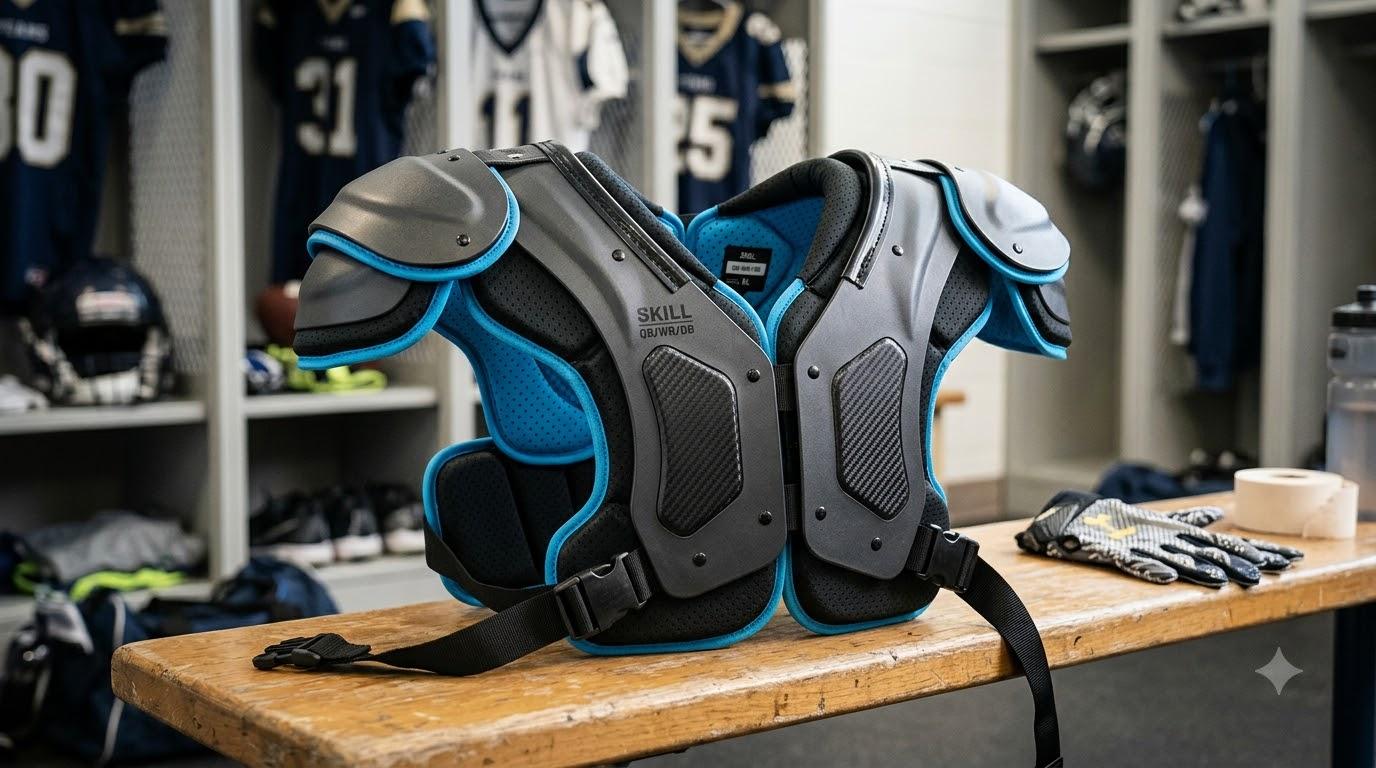
It's a common assumption that "skill position" is one uniform equipment category, but skill position shoulder pads actually need to be evaluated differently depending on whether the athlete is a receiver, running back, or defensive back. Each role involves distinct movement patterns and contact exposure, and treating them identically often leads to equipment that's a compromise rather than a good fit for any of them.
This nuance gets lost because most equipment guides stop at the broad "skill vs. lineman" comparison. In practice, a running back absorbing regular contact between the tackles has different needs than a slot receiver running finesse routes or a cornerback in frequent backpedal and transition movement.
Why Differences Exist Within the Skill Position Category
-
Running backs absorb more regular, direct contact than receivers or defensive backs, despite all three being classified as skill positions.
-
Receivers prioritize shoulder rotation and arm extension for catching, which requires maximum cap flexibility.
-
Defensive backs need rapid directional change during backpedal-to-sprint transitions, placing a premium on low overall weight.
-
Quarterbacks, often grouped loosely with skill positions, need the most unrestricted throwing motion of any position on the field.
Common Mistakes When Treating All Skill Positions the Same
-
Issuing identical pads to running backs and receivers, despite running backs facing more regular direct contact.
-
Prioritizing weight reduction over coverage for running backs, who need more protection than finesse-route receivers.
-
Overlooking defensive backs' specific transition movement needs, focusing pad selection only on receivers and running backs.
-
Failing to separate quarterbacks from the broader skill position category, despite their unique throwing motion requirements.
How to Match Skill Position Shoulder Pads to Specific Roles
-
Separate running backs from receivers and defensive backs in your evaluation, since running backs generally need somewhat more coverage due to regular contact exposure.
-
Prioritize cap flexibility and rotation range for receivers and quarterbacks, where arm extension directly affects performance.
-
Prioritize low overall weight and quick-transition comfort for defensive backs, who spend significant time in backpedal and change-of-direction movements.
-
Test each sub-group through position-specific drills rather than relying on a single generic skill-position fit test.
-
Review contact data from game film if available, noting which skill positions on the roster actually absorb more frequent or harder contact.
-
Reassess pad assignments annually, since a player's role within the skill position category can shift from year to year.
Two Practical Examples
Example 1 — Running Back Using Receiver-Style Pads: A running back wearing lightweight, receiver-oriented pads reports discomfort after games involving frequent inside runs. Moving to a slightly higher-coverage option within the skill position shoulder pads category — while still prioritizing mobility over lineman-style bulk — better matches his actual contact exposure.
Example 2 — Cornerback Needing Faster Transitions: A cornerback using pads originally selected for a wide receiver finds the fit adequate for catching-related movements but slightly restrictive during rapid backpedal-to-sprint transitions. Adjusting to a marginally lighter configuration within the same general category improves his transition speed without sacrificing necessary coverage.
Illustrative Case Study: Differentiating Equipment Within One Position Group
Problem: A youth football program issued identical shoulder pads to all skill position players — receivers, running backs, and defensive backs — based on the general assumption that all three groups had similar needs.
Circumstances: Running backs reported discomfort after contact-heavy games, while receivers and defensive backs had no similar complaints.
Solution: The coaching staff reviewed game film to assess actual contact frequency by sub-position and adjusted pad selection accordingly.
Steps Taken:
-
Reviewed several games of film to quantify contact frequency for running backs versus receivers and defensive backs.
-
Selected a slightly higher-coverage option within the skill position shoulder pads category specifically for running backs.
-
Maintained lighter, more flexible options for receivers and defensive backs.
Outcome: Running backs reported improved comfort during contact-heavy games, while receivers and defensive backs retained the mobility benefits of their existing equipment.
Lesson: Even within the skill position category, contact frequency data should inform equipment decisions rather than treating all skill positions as interchangeable.
Comparing Needs Within the Skill Position Category
|
Sub-Position |
Relative Contact Frequency |
Primary Mobility Need |
Pad Emphasis |
|
Running back |
Medium–High |
Balanced |
Slightly higher coverage within skill-position range |
|
Wide receiver |
Low–Medium |
Arm extension/rotation |
Maximum cap flexibility |
|
Defensive back |
Low–Medium |
Transition speed |
Lowest overall weight |
|
Quarterback |
Low |
Throwing motion |
Maximum shoulder mobility |
Limitations and Trade-Offs
Differentiating skill position shoulder pads by sub-role adds complexity to equipment management, since it means avoiding a single uniform purchase for the entire group. Teams with limited budgets may need to prioritize which sub-positions benefit most from specialized fit, since a fully differentiated approach isn't always practical at every level of play.
What to Do Next
If players within the broader skill position group report inconsistent comfort or performance issues, consider whether their specific sub-role — running back, receiver, defensive back, or quarterback — has distinct needs that a uniform equipment approach is overlooking. Reviewing game film for actual contact frequency by sub-position is a practical starting point for making more targeted equipment decisions.
Frequently Asked Questions
Do running backs need different shoulder pads than receivers?
Generally yes, since running backs typically absorb more regular direct contact and may benefit from slightly more coverage than receivers prioritizing arm extension.
Are quarterbacks considered a skill position for equipment purposes?
Quarterbacks are often grouped with skill positions, but their nearly unrestricted throwing motion requirement makes shoulder mobility an even higher priority than for other skill roles.
How can I tell which skill position sub-group needs more coverage?
Reviewing game film for actual contact frequency by position is a practical way to identify which players may benefit from slightly higher coverage within the skill position category.
Is it worth differentiating pads for a small youth team with a limited budget?
It can still be worthwhile to prioritize differentiation for positions with the most noticeable contact exposure, such as running backs, even if full customization across every position isn't feasible.
How often should skill position sub-roles be reassessed for pad fit?
Annually, or whenever a player's role changes meaningfully within the skill position category, such as transitioning from receiver to running back.

 English
 Arabic
 French
 Spanish
 Deutsch
 Turkish
 Dutch
Dutch
 Italiano
 Russian
 Romaian
 Portuguese (Brazil)
 Greek
Greek