
 LMS
LMS
 Reels Series
Software Testing Interview Questions and Answers for Freshers
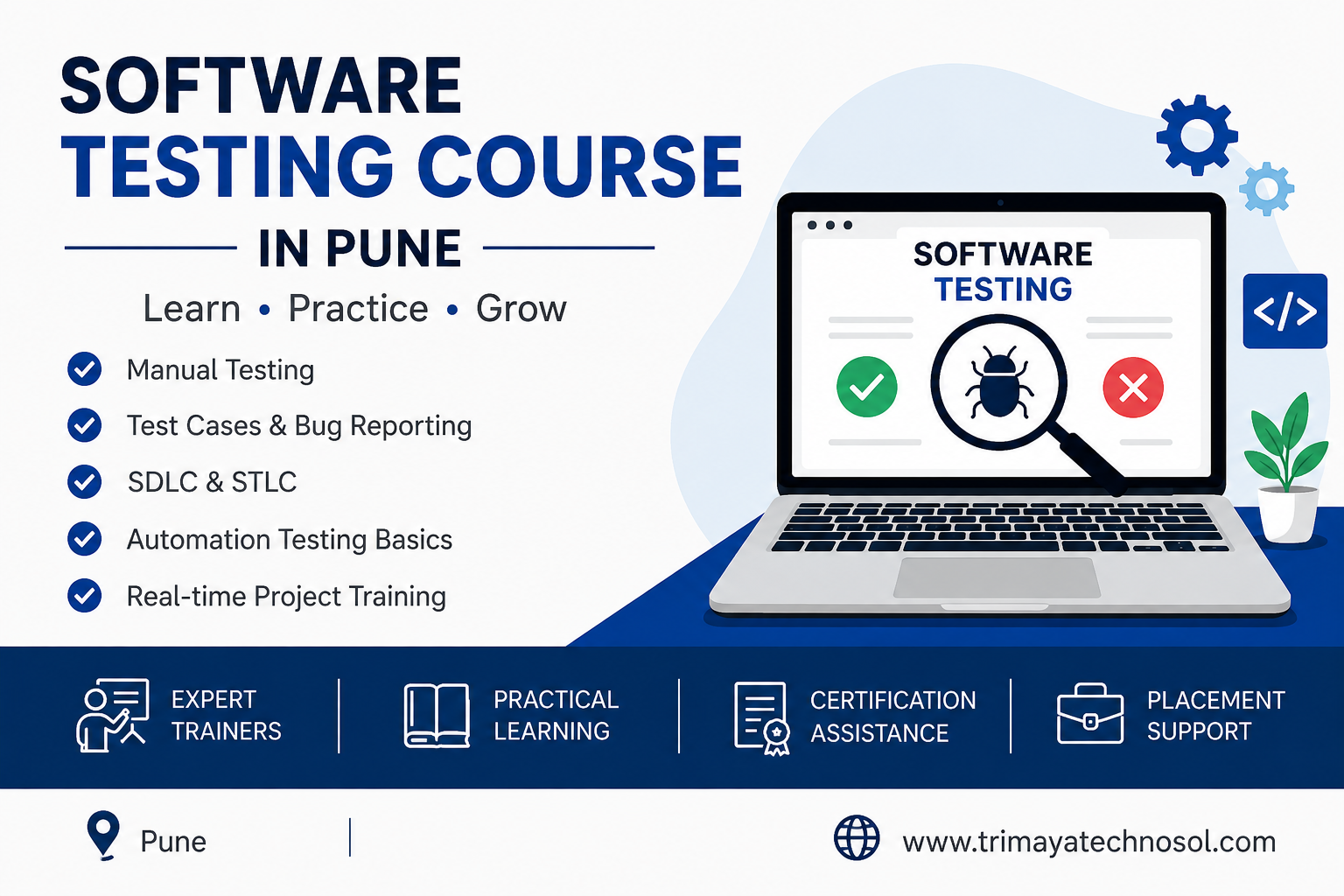
Software testing is an essential part of the software development lifecycle. It helps ensure that applications, websites, and software products work correctly, meet user expectations, and deliver a smooth experience. As businesses increasingly depend on digital solutions, the demand for skilled software testers continues to create opportunities for fresh graduates and aspiring IT professionals.
For beginners, preparing for a software testing interview can feel challenging, especially when they are unfamiliar with testing concepts, methodologies, and industry tools. Understanding the fundamentals and practicing commonly asked interview questions can help candidates build confidence and improve their chances of performing well.
In this blog, we will explore some of the most important software testing interview questions and answers for freshers to help you prepare for entry-level testing roles.
1. What Is Software Testing?
Software testing is the process of evaluating a software application to identify defects and verify that it meets specified requirements. It helps ensure that the application functions as expected, performs reliably, and provides a good user experience.
Example: Testing a login page to verify whether users can log in with valid credentials and receive an appropriate error message when entering an incorrect password.
2. What Is the Difference Between Manual Testing and Automation Testing?
Manual testing involves executing test cases manually without using automation scripts. Testers interact with the application, verify its functionality, and record the results.
Automation testing uses scripts and specialized tools to execute test cases automatically.
Key differences:
-
Manual testing is useful for exploratory testing and usability checks.
-
Automation testing is beneficial for repetitive tests and regression testing.
-
Manual testing generally requires more hands-on effort for repeated execution.
-
Automation testing requires scripting knowledge, tool expertise, and ongoing script maintenance.
Both approaches are important, and the choice depends on project requirements.
3. What Is a Test Case?
A test case is a documented set of conditions, inputs, execution steps, and expected results used to verify a specific application feature.
A typical test case includes:
-
Test case ID
-
Test case description
-
Preconditions
-
Test steps
-
Test data
-
Expected result
-
Actual result
-
Pass or fail status
Example: A test case for a login page verifies whether a user can successfully access an account using valid credentials.
4. What Is the Software Testing Life Cycle (STLC)?
The Software Testing Life Cycle (STLC) is a structured process followed by testing teams to plan, execute, and complete testing activities.
The major phases of STLC are:
-
Requirement Analysis: Understanding the requirements and identifying what needs to be tested.
-
Test Planning: Defining the testing scope, resources, schedule, and strategy.
-
Test Case Development: Preparing test cases and test data.
-
Test Environment Setup: Configuring the environment required for testing.
-
Test Execution: Running test cases and recording results.
-
Test Cycle Closure: Evaluating testing outcomes, documenting lessons learned, and preparing closure reports.
Following these phases helps teams organize testing activities effectively.
5. What Is the Difference Between Verification and Validation?
Verification and validation are two important quality assurance activities.
Verification checks whether the software work products meet specified requirements and design expectations. It often involves reviews, inspections, and other static techniques.
Validation checks whether the actual software meets user needs and intended requirements, typically through execution-based testing.
In simple terms, verification asks, “Are we building the product correctly?” Validation asks, “Are we building the right product?”
6. What Is the Difference Between Severity and Priority?
Severity refers to the impact a defect has on the application's functionality. Priority indicates how urgently the defect should be fixed.
For example, a defect that prevents users from completing a payment may have high severity and high priority. A spelling mistake on a rarely visited page may have low severity and lower priority.
However, priority also depends on business requirements, release schedules, and customer expectations.
7. What Is the Difference Between Retesting and Regression Testing?
Retesting verifies whether a previously reported defect has been fixed successfully.
Regression testing checks whether recent code changes have negatively affected existing functionality.
For example, after a developer fixes a login defect, retesting confirms that the login issue is resolved. Regression testing checks whether other features, such as password recovery or user registration, continue to work correctly.
8. What Is Smoke Testing?
Smoke testing is a preliminary test performed to determine whether the major functions of a new software build work well enough for further testing.
It generally covers critical features such as application launch, login, navigation, and other essential workflows.
If smoke testing fails, the build may be rejected for further testing until the major issues are resolved.
9. What Is Sanity Testing?
Sanity testing is a focused test performed to verify that a specific change or bug fix works as expected and that the affected functionality is behaving correctly.
For example, after a developer updates the search feature, a tester may perform sanity testing to check whether search results are generated correctly.
Smoke testing evaluates the basic stability of a build, while sanity testing focuses on a narrower area after a change.
10. What Is Black Box Testing?
Black box testing is a testing technique in which the tester checks an application's functionality without needing to understand its internal code or implementation.
The tester provides inputs and compares the actual outputs with the expected results.
Common black box testing techniques include:
-
Equivalence partitioning
-
Boundary value analysis
-
Decision table testing
-
State transition testing
This approach is widely used for validating application functionality against requirements.
11. What Is White Box Testing?
White box testing involves examining the internal structure, logic, or code of an application.
It generally requires programming knowledge and is commonly performed by developers or testers with appropriate technical skills.
Examples include statement coverage, branch coverage, and condition coverage.
White box testing helps identify logical errors and gaps in code-level test coverage.
12. What Is the Difference Between Functional and Non-Functional Testing?
Functional testing verifies what an application does. It checks whether features behave according to specified requirements.
Non-functional testing evaluates how well an application performs under different conditions.
Examples of functional testing include login testing, registration testing, and payment workflow testing.
Examples of non-functional testing include performance testing, usability testing, compatibility testing, and security testing.
Both are important for delivering reliable and user-friendly software.
13. What Is a Bug Life Cycle?
The bug life cycle describes the different stages a defect passes through, from identification to closure.
Common stages include:
-
New
-
Assigned
-
Open
-
Fixed
-
Retest
-
Verified
-
Closed
Other statuses, such as Reopened, Deferred, Rejected, or Duplicate, may be used depending on the team's workflow and defect tracking tool.
A tester should document defects clearly, including the steps to reproduce them, expected and actual results, relevant evidence, and the environment in which the issue occurred.
14. What Is Agile Testing?
Agile testing is a software testing approach that aligns testing activities with iterative and incremental software development.
Instead of waiting until development is completely finished, testers collaborate with developers, product owners, and other team members throughout the development process.
Agile testing commonly involves continuous feedback, frequent test execution, collaboration, and early defect identification.
Knowledge of Agile concepts and Scrum ceremonies can be useful for freshers preparing for software testing interviews.
15. What Is API Testing?
API testing verifies whether an application's Application Programming Interfaces (APIs) work correctly.
Testers check request methods, response status codes, response data, authentication, error handling, and response times.
Tools such as Postman can help testers send API requests and validate responses.
For example, when testing a login API, a tester may verify that valid credentials return an appropriate response and invalid credentials produce the expected error.
16. What Is Selenium?
Selenium is an open-source suite of tools used to automate web browsers.
It allows testers to create automated scripts for checking web application functionality across supported browsers.
Selenium WebDriver is commonly used with programming languages such as Java, Python, and JavaScript.
Beginners interested in automation testing should understand basic programming concepts, locators, browser interactions, waits, and test execution.
17. What Is Exploratory Testing?
Exploratory testing is an approach in which testers learn about the application, design tests, and execute them while exploring its behavior.
Unlike strictly scripted testing, exploratory testing allows testers to investigate unexpected scenarios and discover issues that may not be covered by existing test cases.
It is particularly useful for identifying usability problems, unexpected application behavior, and edge cases.
18. How Would You Test a Login Page?
This is a common practical interview question for entry-level software testers.
A good answer should include different positive and negative test scenarios.
Examples include:
-
Verify login with valid username and password.
-
Verify login with an incorrect password.
-
Verify login with an unregistered username.
-
Check the behavior when required fields are left blank.
-
Verify password masking.
-
Check validation messages for invalid inputs.
-
Verify the password recovery functionality.
-
Check that successful login redirects the user to the correct page.
-
Verify that the application handles repeated failed login attempts according to its security requirements.
During an interview, explain your testing approach in a logical sequence and mention the expected result for each scenario.
19. What Is a Test Plan?
A test plan is a document that describes the overall approach and scope of testing for a project.
It may include:
-
Testing objectives and scope
-
Features to be tested and excluded
-
Testing strategy
-
Roles and responsibilities
-
Resources and test environment
-
Schedule and milestones
-
Risks and mitigation plans
-
Entry and exit criteria
A well-prepared test plan helps the testing team understand what needs to be tested, how testing will be conducted, and when testing can be considered complete.
20. How Can Freshers Prepare for a Software Testing Interview?
Freshers can prepare more effectively by combining theoretical knowledge with practical exercises.
Here are some useful preparation tips:
Understand the fundamentals: Learn testing concepts, STLC, test cases, defect reporting, and common testing techniques.
Practice real-world scenarios: Test familiar applications such as registration forms, shopping carts, search pages, and login screens.
Learn defect tracking tools: Become familiar with how bugs are documented, assigned, tracked, and closed using tools such as Jira.
Explore API testing: Practice sending requests, validating responses, and checking status codes using Postman.
Build automation fundamentals: If interested in automation, learn basic programming and explore Selenium WebDriver.
Practice explaining your answers: Interviewers often evaluate how clearly you communicate your testing approach, not just your ability to memorize definitions.
Prepare project examples: Be ready to describe your test scenarios, test cases, defects identified, and the process you followed during practice projects.
Conclusion
Software testing offers a promising career path for individuals who enjoy problem-solving, analytical thinking, and improving software quality. For freshers, understanding fundamental testing concepts and practicing common interview questions can provide a strong foundation for entry-level opportunities.
Along with theoretical knowledge, hands-on experience with test cases, defect reporting, API testing, and automation tools can help candidates develop practical skills. Consistent practice and clear communication are equally important when preparing for interviews.
If you want to build your testing knowledge through structured learning and practical exercises, exploring a software testing course in pune can be a useful step toward developing industry-relevant skills and preparing for a career in software quality assurance.
Start with the fundamentals, practice regularly, and keep learning as testing tools and technologies evolve.
 English
 Arabic
 French
 Spanish
 Portuguese
 Deutsch
 Turkish
 Dutch
Dutch
 Italiano
 Russian
 Romaian
 Portuguese (Brazil)
 Greek
Greek